
Fluoride in Cheney's Water: What We Know Before the October 13 Vote
On October 13, the City Council will vote on whether Cheney stops adding fluoride to its municipal water. Before then, I want to lay out what has happened so far, what the city has said, and what Council has not yet seen, because this conversation has been confusing and I'd rather you hear it plainly.
TLDR: The City Council votes October 13 on whether Cheney stops adding fluoride to its water. The proposal came from the Mayor's office, and Council has not yet received a cost estimate, any option other than removal, or expert briefings. Public comment so far has leaned toward keeping fluoride, including from local dentists. To be heard, email councilcomments@cityofcheney.org, or speak at the 6:00 p.m. meeting in Council Chambers. For Zoom, email by 5:00 p.m. that day.
How we got here
The city announced a formal 90-day notification process with the Washington State Office of Drinking Water and the public as required by RCW 70A.125.210. The flyer was dated July 6 and shared with residents on July 15. The process was initiated by the Mayor's office, and Council members learned of it at the same time the public did. The flyer was headlined "Cheney City Council to Consider Ending Water Fluoridation," and many people took that to mean Council had started this. We didn't. I mention it only so we're all working from the same facts.
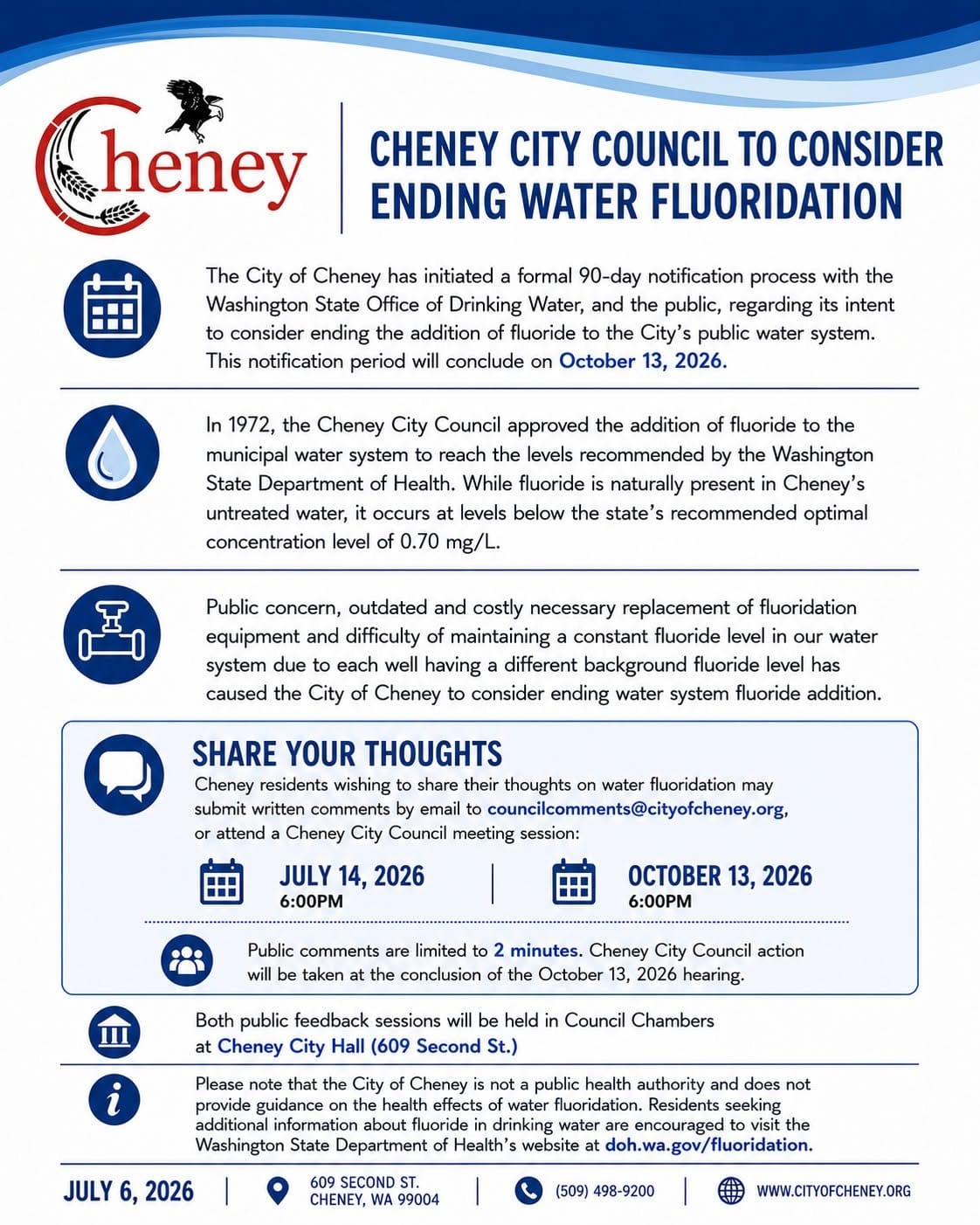
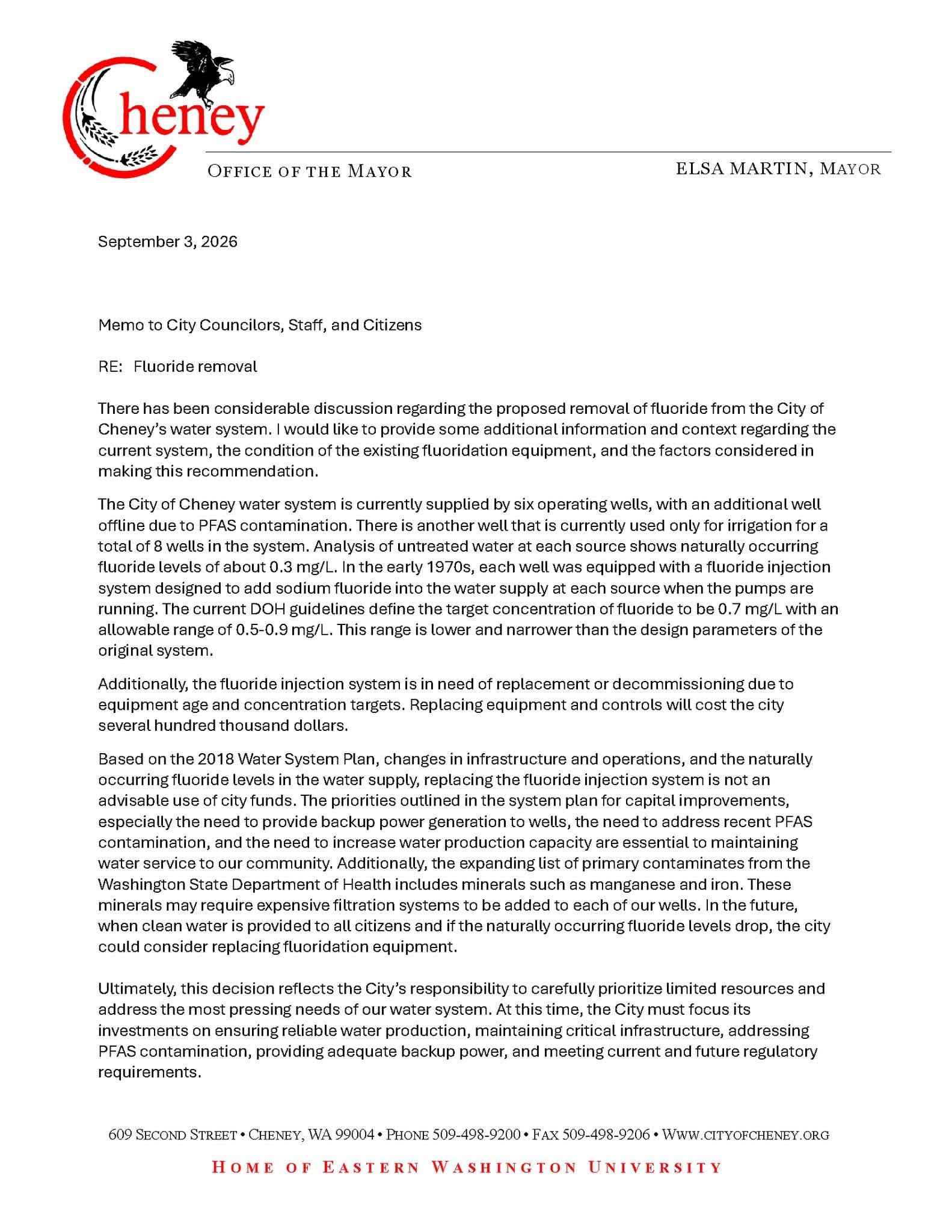
The reasons given have also grown over time. The July flyer cited public concern, aging and costly equipment, and the difficulty of holding a steady fluoride level when each well has a different natural level. The Mayor's September 3 memo added budget priorities, including backup power for the wells, PFAS, and added production capacity.
What the city has said
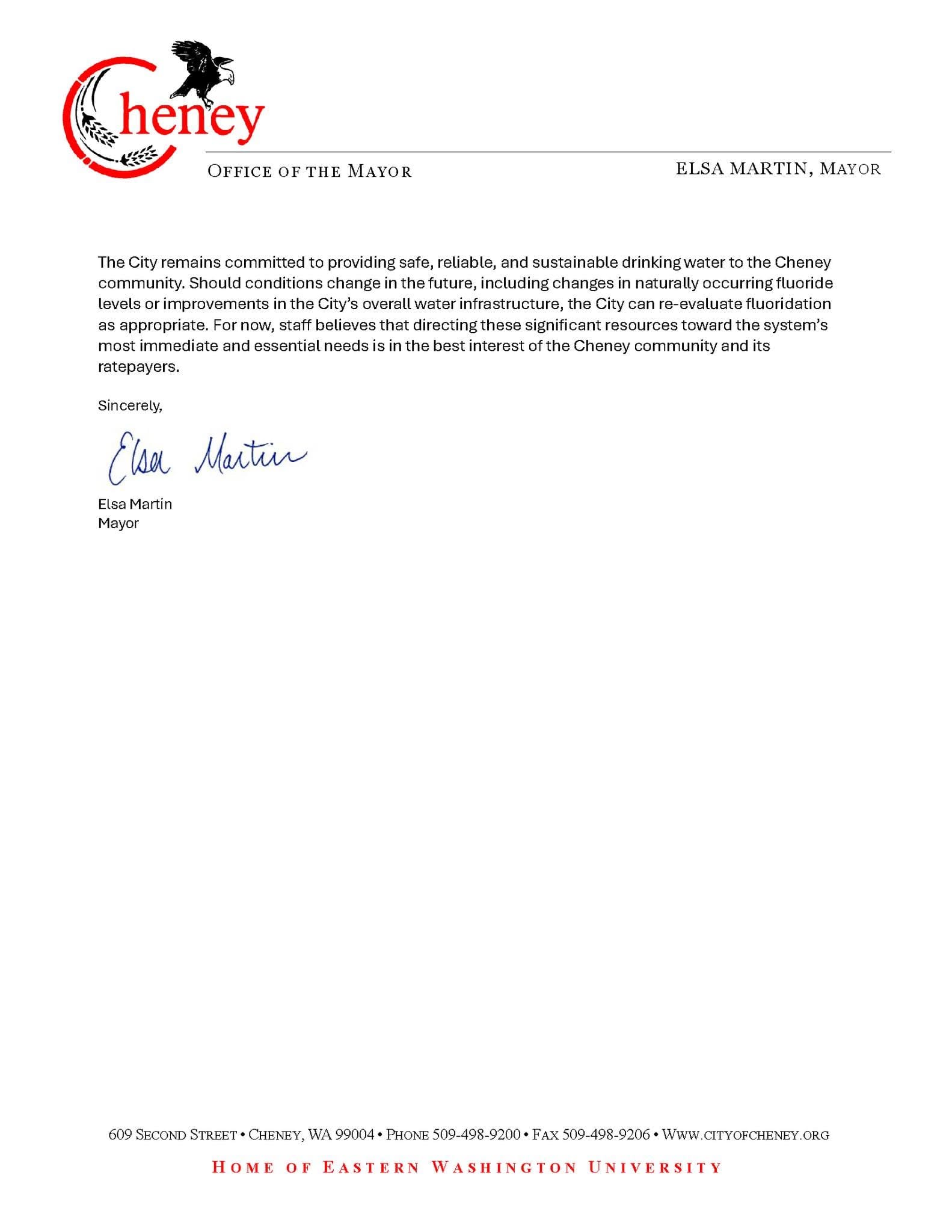
According to the memo, Cheney's wells naturally contain about 0.3 mg/L of fluoride. The Washington State Department of Health recommends 0.7 mg/L, with an allowable range of 0.5 to 0.9 mg/L. Cheney has added sodium fluoride at each well since the early 1970s. The memo describes the injection equipment as aging and in need of replacement or decommissioning, and says replacing the equipment and controls would cost "several hundred thousand dollars." It argues that this is not an advisable use of city funds given other capital priorities: backup power for the wells, addressing PFAS contamination, and increasing production capacity.
Staff has told me that the current system takes more effort to operate but does not need to be replaced right away, and that ending fluoridation would save about $10,000 a year. At that figure, the savings would not fund those other projects. The projects are important, but I'd like Council to see how fluoridation and those priorities are actually connected, since the cost of replacing the equipment may not need to be spent anytime soon.
On PFAS, the contamination is limited to one well near the local fire training facility, and testing has not shown contamination of our aquifer.
What Council has not yet seen
Council has not received a cost estimate or condition assessment for the existing equipment. We haven't been presented with any option other than removal, such as repair, phased replacement, or grant funding. No outside experts have briefed us on the infrastructure or the public health tradeoffs. I'd like to see those before we vote on something that has been part of Cheney's water for more than 50 years.
What residents are telling us
Public comment so far has leaned toward keeping fluoride, and it has included local and regional dental professionals. Cheney dentist Jacob Ridl spoke against ending fluoridation at the July 14 meeting, as reported by The Spokesman Review on July 24. More recently, Spokane dentists have told Council that they can often tell from a patient's teeth whether that patient lives in Cheney, and that Cheney patients tend to have healthier teeth. Spokane has never fluoridated its water. Other residents have written to Council with concerns about fluoride, including questions about neurological research and about adding it through a public utility. Council can only weigh what we hear, so both viewpoints are welcome.
For health information, the city notes that it is not a public health authority. The Department of Health has resources at:
https://doh.wa.gov/community-and-environment/drinking-water/fluoride-drinking-water
How to be heard before the vote
- Email: councilcomments@cityofcheney.org. I'd suggest sending yours early so Council has time to read it.
- In person: Tuesday, October 13 at 6:00 p.m. in Council Chambers, Cheney City Hall, 609 Second Street. Public comment is limited to two minutes, and Council will act at the conclusion of the hearing.
- By Zoom: email councilcomments@cityofcheney.org by 5:00 p.m. on October 13 to participate.
Whether you favor keeping fluoride, ending it, or just want better information first, please tell us. A decision this long-lasting should reflect the people who drink the water. Thank you for your engagement on this!